
Insight · AI to revenue
The AI Value Gap Is an Ops Problem
The question has moved from “what can AI do?” to “how does AI make us money?” The companies answering it fastest are not the ones with the best models. They are the ones that can run AI in production.
- Sep 25, 2026
- 7 min read
of generative AI pilots delivered no measurable P&L impact
95%
of CEOs saw no significant financial benefit from AI
56%
of agentic AI projects predicted to be cancelled by end of 2027
40%+
for mid-market firms to move from pilot to full implementation
90 days
For two years the AI conversation belonged to large enterprises with big budgets and innovation labs. Small and mid-sized businesses asked a sharper question: will it pay for itself? That question is where the next wave of AI value will come from, and the answer is less about technology than about operations.
The value gap, in numbers
Most AI investment has not yet reached the P&L. Across the largest studies of the past year, the pattern is the same: plenty of pilots, very little production.
Only 1 in 12 enterprise AI evaluations reaches production
Share of organisations reaching each stage (percent)

MIT Project NANDA, The GenAI Divide: State of AI in Business 2025 · 300+ deployments, 52 interviews, 153 leaders
The next wave is at risk too. Gartner predicts over 40% of agentic AI projects will be cancelled by the end of 2027, citing rising costs, unclear business value and weak risk controls.
The lesson is not that AI fails. It is that AI which cannot be run, measured and governed in production never gets the chance to pay back.
Why SMBs are the next wave
Smaller firms are better placed to cross the gap than their enterprise peers. MIT found mid-market organisations move from pilot to full implementation in about 90 days, against nine months or more for large enterprises (Virtualization Review).
Adoption is already broad. In Salesforce’s SMB Trends survey, 75% of SMBs were at least experimenting with AI, and 91% of those using it said it boosts revenue. What separates winners from the rest is not whether they use AI, but what they build underneath it.
Growing SMBs invest in data and integration, not just AI
Share of SMB leaders, by revenue trend (percent)
- Growing SMBs
- Declining SMBs
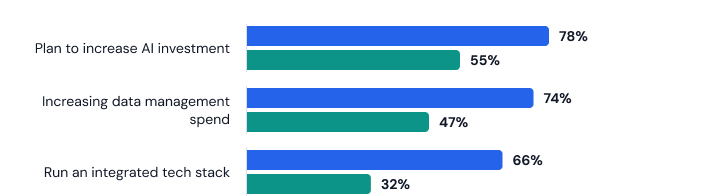
Salesforce Small & Medium Business Trends, 6th edition · 3,350 leaders of firms with up to 200 staff · Aug–Sep 2024
Growing SMBs are twice as likely as declining ones to run an integrated tech stack. Trust matters too: 81% of SMB leaders say they would spend more on technology from vendors they trust.
Stuck in the pilot trap
Pilots stall for four reasons, and only three of them are about technology. A promising proof of concept, an impressive demo, genuine excitement in the room. Then months pass and the pilot is still a pilot: admired in meetings, absent from daily operations.
Three technology questions and one business question decide every pilot
Technology
Business
Cost
Will it pay for itself?
Costs lead Gartner’s cancellation reasons
Control
Who owns the data and the outcomes?
Security is the top SMB tech concern
Choice
Which model, tool or approach?
Only ~130 agent vendors are real
Context
Does it solve a real business problem?
Brittle workflows stall most pilots
Where technology meets business
The four Cs · evidence lines from Gartner, Salesforce and MIT (cited above)
Get cost, control and choice right and you have sound technology. Add context and you have business value. That is why the most useful first question is never about the model:
✕ The question that stalls projects
“What can we do with AI?”
The question that drives revenue
“Where are we losing money, time or customers?”
Where AI moves the needle for SMBs
The winning projects target a process that already costs money or caps growth, and each has a public benchmark to measure against.
| Area | What AI does | The benchmark to beat | The outcome |
|---|---|---|---|
|
Finance operations |
Invoice capture, reconciliation and matching, accounts payable automation |
The average invoice costs $9.84 and 8.2 days to process; best-in-class teams are 79% cheaper and 79% faster (Ardent Partners, State of ePayables 2025) |
Faster cash cycles; scale without matching headcount |
|
Customer engagement |
AI agents for routine enquiries, lead qualification, round-the-clock support |
Gartner expects agentic AI to resolve 80% of common service issues by 2029, cutting operating costs 30% ( Gartner) |
A small team that performs like a large one |
|
Sales and operations insight |
AI on top of ERP and CRM data, early warning on at-risk customers, clearer pipeline forecasts |
Firms applying AI widely to products, services and customer experience earn nearly 4 points higher profit margins ( PwC) |
Decisions from data you already own |
- If you can measure it in hours saved, cash collected or customers kept, it’s an AI-to-revenue use case.
Closing the gap is an operations problem
Both findings point to the same fix: treat AI as a running service, with a data foundation beneath it and an operating loop around it.
One functional stack, run through one continuous AgentOps loop
Users and channels
Staff, customers and partners via chat, apps and APIs
Agentic AI
Orchestration · tool gateway · memory · policy
Generative AI
Models · RAG · fine-tuning
Predictive ML
Features · training · registry
Data foundation
Data lake · migration · modernisation · DataOps

- repeats every release
Security, governance and FinOps
Identity · guardrails · audit · cost per tenant
AgentOps and AI/ML Ops reference functional architecture · AdamasTech
Read it bottom up. Governed data feeds generative and predictive models; agents act on top; and every agent and model goes through the same build, evaluate, deploy, observe and improve loop. The loop is what turns a demo into a system that learns.
The missing piece: the right partner
The toolkit is ready; what most SMBs lack is an in-house team to turn it into results. Salesforce found 81% of SMB leaders would spend more with technology vendors they trust. We earn that trust with a consultative, joint-team approach.
We build agentic workflows and GenAI apps embedded in real business processes. Because AI is only as good as the data beneath it, we start from the ground up, with deep expertise in data lakes, data migration, data modernisation and DataOps. The result is AI that runs on trusted, well-governed data and keeps delivering long after launch.

AWS Advanced Tier Services Partner
Working across the UK, UAE and India

AWS AI Competency Partner

Platform and AI-assisted managed services
That keep AI solutions secure and running

SAP and Oracle NetSuite ERP expertise
Connecting AI to where revenue and cost actually live
Your first 90 days
No open-ended experiments: a clear line from investment to return in 13 weeks, which matches the roughly 90-day pilot-to-production pace MIT observed in mid-market firms.
One functional stack, run through one continuous AgentOps loop
Discover
Weeks 1–2
Pick the process that costs the most
Build
Weeks 3–6
Prepare the data, deploy on AWS
Prove
Weeks 7–10
Measure against the business target
Scale
Weeks 11–13
Roll out what works and plan the next

target agreed
ready to scale
AdamasTech 90-day AI-to-revenue plan · 4 phases, 2 gates
The first gate matters most. Many pilots report “no impact” simply because no one recorded a baseline, so we agree the baseline and target before anything is built.
Four questions to ask before you start
Answer these four and you already have the outline of a strong first AI project.
What would success look like in 90 days, in hours, cash or customers?
Which process eats the most manual effort or causes the most delay?
Where would faster, better decisions have the biggest commercial impact?
Is the data behind that process accessible and reasonably clean?
Sources

Talk to us
AI to Revenue: Winning the SMB Opportunity with AWS
AdamasTech Consulting and AWS help SMBs move beyond pilots and turn AI into measurable, revenue-driving growth. Talk to our team to see what that looks like for your business.

Pranab Das

Shouvik Sen

KayCee

Sanchita
Talk to our team to book your 90-day AI-to-revenue discovery.